Ken Rodgers, the Managing Editor of Kyoto Journal, passed away in Kyoto in November 2024, the Year of the Wood Dragon. 72 years earlier he was born in Tasmania in 1952, the Year of the Water Dragon. This remarkable man lived a rich and rewarding life over the six zodiac cycles (of 12 years each) he was physically on planet Earth.

The essence of Ken, my favourite photo of him. This joyful image at Kiyotaki was featured in ‘Water in Kyoto’(KJ101), a special print issue of Kyoto Journal released in 2022. Photo by John Einarsen.
Many tributes have been written for Ken including in the Japan Times. He was much loved and admired and is deeply missed. These celebrations of Ken’s life focus on the 42 years he lived in Japan, transforming the cultural scene in Kyoto through his seminal contributions to Kyoto Connections, Kyoto Journal, Writers in Kyoto and much more. The following excerpt was written by John Einarsen, who cofounded Kyoto Journal with Ken.
“His integrity was the soul of Kyoto Journal. He loved real things—birdsong, the growth of plants in his garden, a sunset over the hills—things with true substance. He had zero tolerance for the superficial. “Connection” was a vital word for him, whether with people, nature, or finding the interrelated strands between articles within the magazine. He was a wonderful writer himself and composed many poems and travelogues, but was always too humble to publish them. He did so much for all of us.”
To complement these heartfelt remarks, this homage reflects on Ken’s formative decades lived in the southern-most state of Australia, where I currently reside, and on our shared experiences since we first met in 2017. It draws on Ken’s recent comments about his time in Tasmania and exchanges we’ve had over the years. The elements of water and fire feature in both our life stories.
Ken’s earliest memory in Tasmania of ‘something Japanese’ was on a windswept Southern Ocean beach. There he discovered a woven-straw sandal with black velvet straps, and mysterious bamboo tags inscribed with kanji, originating from far-ranging Japanese tuna fishing boats. In 1963, when Ken was in 6th grade, one of the boats made an emergency port call; the Hobart Mercury newspaper snapped him with one of the crew.

These recollections and the newspaper photo are part of the ‘first experiences’ article in ‘Cultural Fluidity’ (Kyoto Journal 106) edited by Lane Diko and published digitally in 2024. As Managing Editor of Kyoto Journal since 1993 Ken was involved in each issue to varying degrees.
While living in Tasmania Ken had a strong affinity with water and the sea, especially in the South West of the state where he travelled on boats to the remote bays and islands found there. If he was still in Tasmania he would definitely have a yacht to continue exploring these wild areas he told me. As it turned out Japan had other plans. His love of water continued there, shown in the delightful image at the river at Kiyotaki where friends and family would spend all day in summer, and the many photos he shared of rice paddies filled with water and reflections of the sky.
Reflecting on what stimulated his lasting interest in ‘things Japanese’, Ken credited it to his life-long friends Mark and Keryn Fountain buying the first issue of ‘Whole Earth Catalogue’ in the 1970s. Ken was still living in Tasmania at the time. The counterculture catalogue was based on providing access to ideas and tools, in the broadest sense. From this exposure Ken learnt that Japan had the best tools and that they were often counter-intuitive.

Ken shared stories from his early decades in Tasmania in a video he recorded for the September 2024 down-under launch of ‘Fire & Kyoto’ in Hobart. More details follow.
To learn more, Ken read many books related to Japan. His starting point was the classic ‘Zen Flesh, Zen Bones’ compiled by Paul Reps, which Ken said he immediately tried to internalise. This was shortly followed by the Ivan Morris translation of ‘The Pillow Book’ by Sei Shonagon which he bought from a bargain bin in the Cat and Fiddle arcade in Hobart. Ken noted this was by far the strangest and most other worldly book he had encountered at that point. He read books by Jun’ichiro Tanizaki including ‘In Praise of Shadows’, (translated by Thomas J. Harper ad Edward G. Seidensticker), Yusunari Kawabata including ‘Thousand Cranes’ and ‘Snow Country’, Basho’s linked verse in ‘Monkey’s Raincoat’, translated by Maeda Cana, and more besides.
During the 70s Ken also explored various “wildly disconnected occupations” in Tasmania and quit several safe public service jobs. One of these was editing 16 mm black and white film (pre-video) at the ABC (Australia’s National broadcaster) that he described as a valuable formative editing experience. Ken also worked in an iron ore mine in NW Tasmania, living in his campervan in Rosebury. He felt this helped him prepare for the capsule hotel in Tokyo where the small sleeping spaces are embedded in book-filled shelves!
Before travelling to Japan in 1982 on a work visa, Ken said he had developed a personal mental image about the country that like many other misguided foreigners had hardly any relation to the culture and society he discovered when he arrived. He ended up staying for over 4 decades, in a place that resonated with his values and lifestyle. The four distinct seasons in Japan were particularly appealing he told me. Ken connected with many people in Kyoto and beyond including like-minded expats. The rest is history.
My first encounter with Ken and his wife Yuri in Japan was in June 2017 at their place in Iwakura, Kyoto. A large Australian bottle-brush graces the walkway to their home. Ken described the flowers, shown below, as celebrating spring in both Japan and Tasmania. Ken held both hemispheres in his heart.

A hawk moth and bottle brush flowers at Ken and Yuri’s place in Kyoto. Photo by Ken Rodgers.
We shared many photos, ideas, opportunities and experiences over the ensuing years, mostly related to our shared interests in Buddhism, Fudō Myōō, Kukai, the elements, nature and Tasmania. The travelogues from Ken’s spiritual journeys in Japan and overseas are special treasures. More recently Ken sent many photos and videos of his grandson Gen, often including the two of them looking extremely happy.
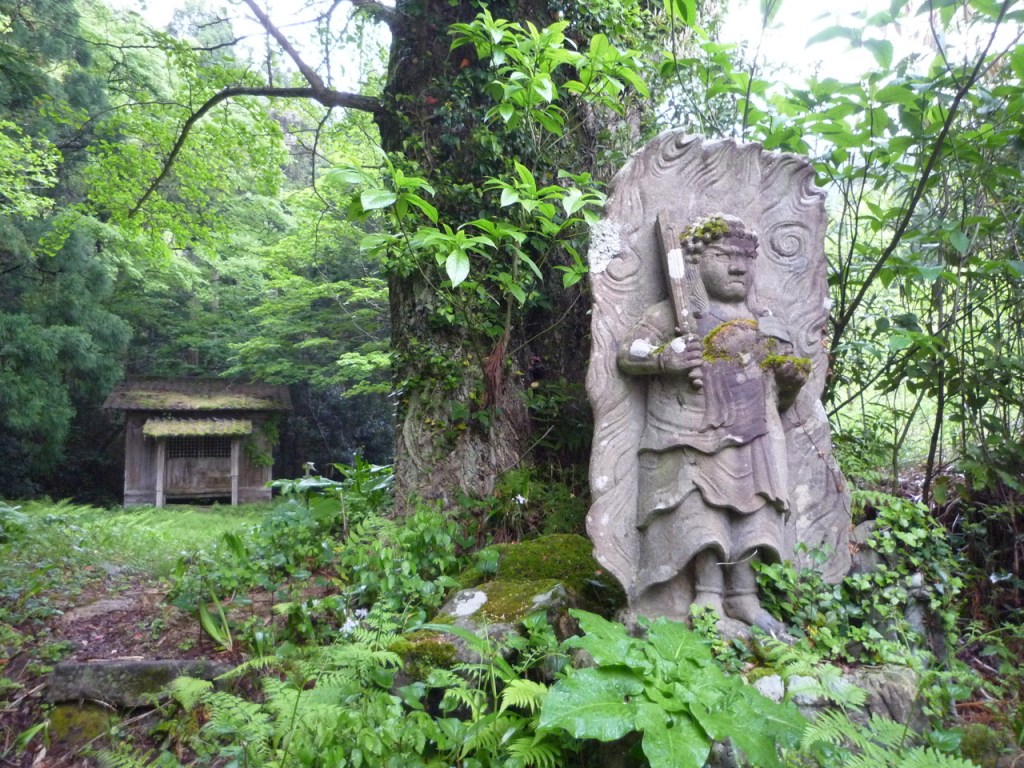
Described by Ken as a “Frodo-ish bare foot Fudō Myōō where the fire looked like a wave”, this image was taken on the Oki Islands in 2017. It was the first of many pictures of the ‘Immovable Wisdom King’ we exchanged over the coming years. Photo by Ken Rodgers.
Between June 2023 and September 2024 I had the great honour of working closely with Ken as Guest Editor of ‘Fire & Kyoto’, the special print issue of Kyoto Journal for 2024 (KJ107). He was a marvellous mentor, wordsmith and support, guiding me through the whole process.
Ken generously took time to work on KJ107 when visiting his family and friends in Tasmania in February/March 2024. We met twice in Hobart, discussing progress with the journal at his sister Caroline’s home and in the Botanic Gardens, an institution his friend Mark was Deputy Director of for 25 years. Ken proudly showed me some of his recently rediscovered early landscape illustrations drawn in Tasmania. They had a distinct Japanese sensibility. Another lasting impression during our time together in Tasmania was when he picked me up in his sister’s convertible. He looked so cool!
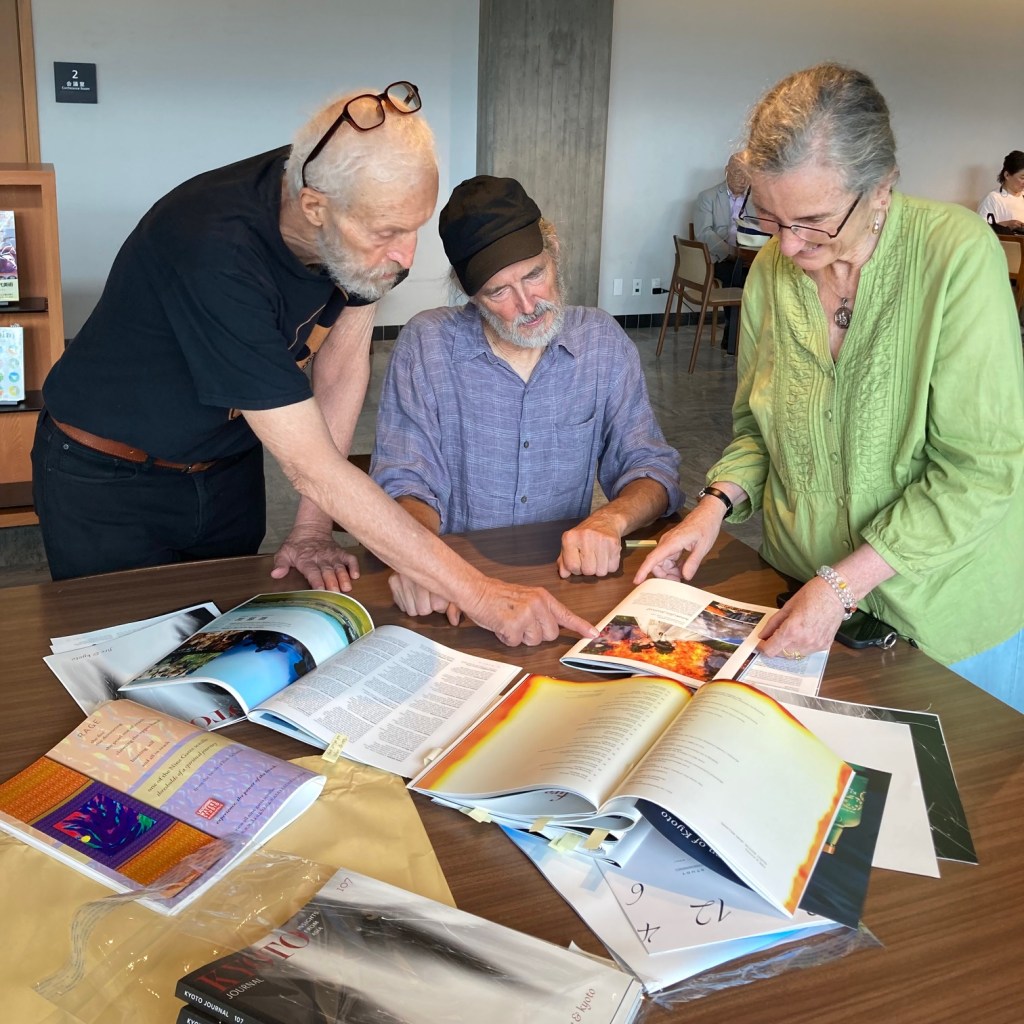
Back in Japan, viewing the proofs of ‘Fire & Kyoto’ with Ken and John Einarsen in late June 2024. Photo by Alex Mankiewicz.
‘Fire & Kyoto’ was published in mid-July 2024. Ken contributed two articles and made exceptional contributions behind the scenes. While shying away from formal recognition, the success of the publication has much to do with Ken’s oversight of the content and John Einarsen and Hirisha Mehta’s mastery in designing the special issue. Only available in print, it can be ordered from the Kyoto Journal website: https://kyotojournal.org/product/kyoto-journal-107-fire-kyoto/

The captivating front cover of ‘Fire & Kyoto’ features an image by Tobias Hutzler. Ken assisted Tobias capture a series of photos of fire interacting with other elements, including water, for the special issue.
Ken was unable to attend the down-under launch of ‘Fire & Kyoto’ held on September 28th at MONA in Hobart. Instead, he produced an 8-minute video that is a wonderful record of his connection to Tasmania and the evolution of Kyoto Journal, some of which is used in this tribute. Mark and Kerry Fountain attended the launch as did other of Ken’s friends and long-time Tasmanian supporters of the Kyoto Journal. We were devastated by his passing less than six weeks later.

Following the launch David Walsh, the founder of MONA, approached Kyoto Journal to buy all the printed issues for his new library. Ken was delighted with this development, describing the Museum as a world class institution. Knowing that visitors to Hobart will be able to access the magazine that Ken dedicated nearly 40 years to is a fitting memorial to his legacy and the decades spent in both Tasmania and Japan.

The Japanese Garden in the Hobart Botanic Gardens – one of the many connections between Tasmania and Japan that Ken personified.
 Elemental Japan